








|
|
|
|
|
|
|
|
|
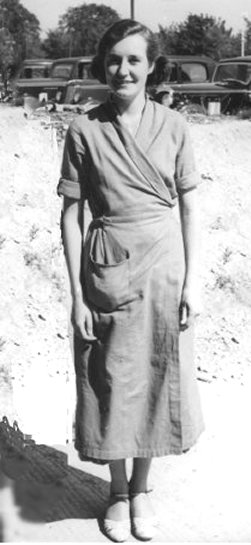 |
From December 1941 all women aged 18 to 50, except those exempted, were required to do National Service. They could either join one the uniformed women's services or seek work in a factory. The uniformed women's services have only recently been given the attention they deserve. However the contribution made by the women factory workers must be among the most neglected aspect of the second world war. The factories where they worked were the target of enemy bombers and their homes were near those factories. They worked long hours, spent nights in air raid shelters and survived under food and fuel rationing conditions. Individual portraits of women factory workers are scarce showing none of the pioneering spirit shown by the Munitions workers of the previous war. The novelty had gone. The wrap around overall shown on the left belongs to this era. This style would of course wrap around differing sizes of worker.If the work allowed women would always choose to wear wrap-overalls over skirts or dresses or perhaps bib and brace dungarees as shown on the right. Boiler suits were unpopular with women who were obliged to practically undress just to use the toilet.However group phtographs of factory workers show that the majority of women wore boiler suits.They would also have worn headscarves tied in a turban or "snoods" which were enlarged hair-nets, for both protection from dirt and safety reasons. But in every group photograph I have seen of factory workers the women are bare headed. |  |
• In most factories the BBC radio programmes " Music while you work" and "Worker's Playtime" | ||
• was piped over the factory loudspeaker system. | ||
  |
  |